LIKE SOMEONE IN LOVE (WITH JAPAN) – Part 5
Japan as seen on film from without
Memoirs of a Geisha (2005)
Arthur Golden’s bestselling, controversial novel (not memoir) was always going to be difficult to resist, especially in a Hollywood newly enamoured of, on the hand, those accoutrements of Japanese history and culture as could be visibly packaged to cinema tourists, and, on the other, with a clutch of Asian (though NOT Japanese) actresses in various stages of making their names on the world stage. Two and two here would surely equal a marked box office four. Throw in director Rob Marshall, fresh from the Oscar successes of Chicago (2002) and what could go wrong? In truth, leaving aside questions of a Japanese narrative filmed in America and cast with Chinese actresses speaking English, there is an opulence to the film, a sense of melodrama, that is an apt means of engaging with both the textual and indeed extra-textual determinants on this production. Japanese films about such characters, like Mizoguchi Kenji’s A Geisha (1953) or Fukasaku Kinji’s The Geisha House (1978), tend to present their protagonists as studious and devoted, as professionals even though their profession has been necessitated by circumstance and has been acquired at significant personal cost. Here, familial hardship and tension give way to professional rivalry and competition, internecine fighting amongst girls in a single house and
Whether this melodramatic register sits well as a vehicle for the more seriously dramatic intent of this film’s development is, perhaps, arguable, but it is commensurate at least to highlighting the extent to which the figure of the Geisha remains a very specific cultural construct. The story concerns the Geisha of the title, Sayuri, who as a child is sold to a geisha house and rises through its ranks to become a celebrated figure. But at what cost? Golden’s source novel is but one example of Geisha stories and indeed memoirs – the most internationally successful but in no way the most telling of a series of autobiographical non-fictions – and these can generally be categorized in two ways: either stories of success or of interminable struggle. Sayuri directly echoes, indeed conflates, these stories in her narrative of familial hardship and privation that necessitates her sale into a geisha house but which provides a foundation for individual success and the group tensions and recriminations that said success almost inevitably entails. Memoirs of a Geisha has much less interest in the protracted making of a geisha that its Japanese counterparts evince. Its opulence is keyed into an artificial world, a façade, a world in which real feelings and emotions must be sublimated. For all the controversy over the novel’s narrative and its ersatz world replete with pretensions to unfettered access behind closed doors, it is this cinematic confection that in fact stands out the most.
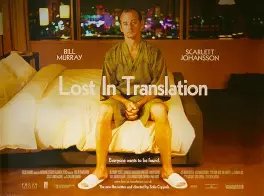
Lost in Translation (2003)
The manic, hyper-saturated, camp, effervescent effusions of Japanese pop culture are offset by isolation and loneliness in Sofia Coppola’s much-vaunted sophomore film. Lost in Translation looks to Japan as a curious and alienating Other, narrativizing this Otherness to the extent that bemused detachment and curiosity become the watchwords and the default positions. As has become typical of Coppola, feelings of alienation and ennui within a rigidly circumscribed milieu are writ large, here in the story of two characters who come together whilst in Japan and who bond amidst their shared boredom, loneliness and personal disenfranchisement. One, Bill Murray, is an actor recording an ad for Japanese Whisky (something many Hollywood actors have actually done and continue to do), whilst the other, Scarlet Johansson, is with her husband (a photographer) and is left to her own devices whilst he is working. They begin to meet, and over the course of only a handful of days they share what may be termed adventures – visiting various places of interest, hanging out in bars, a visit to the hospital, etc – and lament their variously empty and directionless existences. Both are suffering ennui; both are in a practical position to indulge such feelings of ennui, to travel where they will; so that any audience sympathy is to my mind tested and found distinctly wanting. The fact that both Johansson and writer/director Sofia Coppola (making her sophomore feature) are both given to gazing out across the skyline of downtown Tokyo suggests an attachment to her character that frames the film as a very personal response to a city and a culture. And this is the both the best and worst of the film.
The extent to which Lost in Translation is, ultimately, about experiencing Japan and Japanese culture from the outside is debatable. Japan seems a vehicle for the odd couple relationship throughout, an interlocutor for lonely souls and a stage upon which the pair never feel like performers or participants, even though they throw themselves into pastimes like Karaoke. The film’s vision of the country is perhaps overly reliant on cliches pertaining to how Japan figures in the popular consciousness of the West. There is a proliferation of encounters wherein the two protagonists are confronted with Japanese who variously amuse and bemuse them, and an awkward, if not crude, equivalence wherein a US actress (Anna Faris) is presented as a complete airhead doesn’t quite negate this dynamic. Indeed, it stresses instead a lowest common denominator that feels rather reductive, facile and crude.
Yet nonetheless this is an involving and quietly engrossing story that overcomes these not- insignificant drawbacks; and if it engages with surfaces then this is not necessarily a further shortcoming. A prevalent postmodern sense in which spaces, texts, ideas of great divergence and disparity are enmeshed together flows through Coppola’s picture like a stream, carrying along its lost souls. In one scene Johansson wanders through seemingly contiguous spaces, one featuring a blockbuster US film press conference and the other a class on Ikebana, which exemplifies this practice, and offers a schism with which many who know Japanese culture (including appropriations thereof such as Blade Runner [1982]) will be familiar. This is perhaps its own quasi-Orientalist cliché, and though it is arguable the extent to which the director recognises it as such, its obvious ramifications for personal and cultural dialogue are salient, and importantly do not intrude on the drama, which is for all its issues involving and moving.
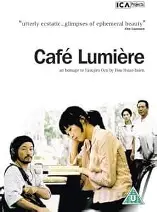
Café Lumiere (2003)
The Taiwanese director Hou Hsiao-hsien, one of the leading lights of his country’s 1980s New Wave cinema, has often been compared to Ozu Yasujiro, and has expressed his admiration for said filmmaker on numerous occasions (even though the equally frequent comparisons between the two made by critics have often overstated the direct influence of the latter on the former). In Café Lumiere, produced in Japan by Shochiku studios (where Ozu spent the bulk of his career) as part of a centenary celebration of this director’s birth, there is a dialogue with Ozu, a reflection on this director, his cinema, his themes, and the society – the Japan – that his work documents as opposed to Japanese society and culture now.
The film concerns a young woman, Yoko, who having returned from conducting research on a composer in Taiwan spends time with her friend, a café owner named Hajime, and with her parents. The revelation that she is pregnant but wants to have the baby and raise it by herself becomes in effect the crux of the narrative. But although her relations with her parents are shaped by the tension this facilitates, try as they do to talk to her about her decision (if not necessarily to contravene it), this in truth takes up comparatively little of the narrative, certainly less than one would expect from any simple synopsis. This is not a film of plot, of cause and effect or even of narrative exegesis as anyone familiar with Ozu might know and celebrate it. It is certainly a film in which themes dear to the heart of the director of Late Spring (1949) and Tokyo Story (1953) are apparent. However, it is no cinematic hagiography or copybook, and indeed uses Ozu as a point of departure in its own quietude and simple everyday observations.
To this end, and interestingly Yoko’s mother is the most vocal and forthright in questioning Yoko’s action and attitude, though it is her husband that she almost defers to in insisting that Yoko be addressed about her decision, that she must be questioned, if not opposed. There is in this something of an antiquated reverence to the father as patriarch, as head of the family; said father is, however, largely resistant to saying anything, and indeed seems inclined not to overly chastise his daughter or involve himself too much in her affairs. A late scene in Yoko’s apartment in which her pregnancy and boyfriend are discussed features her father sitting and saying not a word as the two women discuss the practicalities of Yoko’s pregnancy and desire to raise her child alone tellingly frames this ostensible patriarch in the centre of the frame. In a low, Ozu-like eye-level shot (often referred to as a Tatami shot for its propensity to look directly at characters who are typically kneeling on the Tatami mats that are still typical in Japanese homes), the women discuss Yoko’s pregnancy openly and candidly. In the shot, though, they remain peripheral, and are further compositionally masked, obscured, throughout what is (typically for Hou, though not for Ozu) a long take. A direct view of Yoko is frustrated by her mother sitting in front of her, and the latter has her back to the camera, thereby obfuscating her face as she questions her daughter. The tension here between an assumed patriarchal centrality (personal, social) and the consequent marginalization of women is simultaneously underlined and undermined in this scene. There is no value judgement on any party, no sense of validation or otherwise of any point of view; rather, there is problem adumbrated, observed, the extent to which it is perceived to be Japanese dependent on individual perceptions of Japanese-ness, which is of course a perennially movable feast.
The minimalism and de-dramatized structure and style of Café Lumiere thus owes little to Ozu. Although Ozu’s work abounds in the quotidian and the everyday his films in fact are replete with drama, conflict and resolution. The intertextual presence of this director is, then, less-than prominent. The centrality of a generational divide and of a young girl desiring her own path through life, though a career and a relationship, is the clearest indicator of any debt. The fact that Yoko is pregnant but desires no union with her erstwhile partner feels like an organic extension of the struggles for personal and social autonomy that frequently beset Ozu’s female protagonists. Yet in truth beyond this connection there is comparatively little that directly recalls the supposed cinematic progenitor here. What Hou provides is a consideration of the viability of Yoko’s position, her social and personal autonomy, rather than Ozu’s more direct and subtly impassioned interventions in the same, his more obvious appeals (understandable and far more proactive for the times during which he was working) to a liberal sensibility about women in Japanese society. It offers a fascinating sense of a country ill at ease with itself and its development and contemporary identity, though throughout this is implicit. Even Yoko herself is not lionized for her decision. She remains steadfast in her desire without really appearing to have thought through its many implications. Perhaps her estrangement from her biological mother and perceived neglect (though this is never explicitly raised in the narrative) suggests an over-determination to be everything and everyone for her child. At the same time there is also a sense of personal social agency in the wake of (perceived) gender inequalities. She does imply that her boyfriend’s family is conservative and that she would be expected to work in their business rather than pursuing her own research and career, and that this is in no way her wish. At the same time there are few if any serious obstacles to this wish; it does not at all feel like a pipe dream or even a goal especially difficult in the achieving. It is as though there is an ingrained shadow consciousness (and this is where Ozu is key) that feels historically like an obstacle even though today it remains much less so.
Hou’s film is, then, as much about internalised struggle as a struggle with social norms or conventions. Yet somehow one feels this is not the whole story: that a young woman as seemingly wilful and single-minded as Yoko would not succumb to such a life and impingement on her professional and personal freedoms. Travel is a key metaphor here. If there is an overt link to Ozu in Café Lumiere then perhaps it is the presence of trains. Scenes on board or shots of trains are common throughout Ozu’s oeuvre, and Hou amplifies this trend (literally) in the person of Hajime. This character’s main hobby is recording the sounds of different trains in and around Tokyo and using said sounds to produce, in effect, an audio map of the city. There is little narrative import to these scenes, no plot points encompassed in or through this pass-time; but thematically they relate to a sense of the city space as a conceptual and/or perceptual construct. Hajime tells Yoko that one day his recordings may be used as evidence in a criminal case; but once again this does not bespeak any concrete motivation or reasoning. He is not undertaking this activity to this end, merely offering a justification lest he be thought strange (which he is not as Yoko is amazed by his work). It is simply a passion, one the director(s) share, the sense of a personal response to a potentially impersonal space linking pro and extra-filmic agency in a subtle and powerful way.
Ultimately, Café Lumiere is the kind of film that wears its serious themes lightly, a film that one can relax into and feel suffused by its meaning without being suffocated thereby. At the risk of labouring a point it is akin to being washed in water or sunlight wherein contrastive implications inherent in these experiences (of being dirty or cold) make the simple pleasures they afford all the more pleasurable. In Japanese (and Chinese) art empty space is never empty; it remains charged with meaning and bestows meaning on what is presented, something expressed beautifully in the work of painter and designer Ogata Kōrin. A recent study of said work is entitled What Isn’t Painted Still Speaks, looking at his depiction of Irises and the way he abstracts these in ‘blank’ space while still suggesting depth and perspective. Indeed, the Japanese title of Hou’s film – Kohî jigoku – translates as Coffee, Time, Light, which underlines impermanence, transience, abstraction, as well as the specific temporality of the everyday, its longueurs, its protractions and procrastinations, its wandering, wavering dialogues and the time spent being rather than doing.
It is, moreover, a pointed, poetic invocation of the film’s unhurried, ostensibly undramatic immersion in a life, a way of life, a city, a culture, a professional and a personal experience. We drop in on a character in this world and later almost float away from her as veteran cinematographer and frequent Hou collaborator Mark Lee Ping Bin’s camera looks down on Tokyo’s railways (as it would do in the later and similarly transnational Flight of the Red Balloon [2008]). There is no dramatic arc, no real change or development in the protagonist, no inciting incidents or clear resolutions. We observe, feel, experience a life being lived, a life not marked or informed by typical tenets of narrative structure, and one centred on someone not riven with any conventional tenets of characterisation wherein a sense of clear definition, motivation, progression, is paramount. Despite tensions bubbling beneath the surface this is a becalming film, and it has been significantly underrated.
Letters from Iwo Jima (2006)
The second part of Clint Eastwood’s WWII diptych based around the battle between US and Japanese forces for the island of the title, Letters from Iwo Jima considers the Japanese side of the story following Flags of our Fathers and that film’s depiction of the stories around the raising of the flag of victory on Iwo Jima. Principally it concerns the exploits of two characters. One is a general, Kuribayashi, facing resistance to his battle plans as he is tasked with defending the eponymous whilst the other is a young soldier, a conscript named Saigo, struggling with the drudgery and deprivation of digging trenches and tunnels, reflecting on the pregnant wife he had to leave and dealing with the zealotry of the Japanese war machine. The former, played by Watanabe Ken (before Tanaka Hiroyuki took up the mantle as the go-to Japanese actor for Hollywood productions), is a stoic and noble leader, perhaps a little too much so given the fanaticism of some of those around him, and by extension of the Japanese militaristic regime. He had travelled in the US as an ambassador and emissary (Pre-WWII letters by the real Kuribayashi formed the foundation of this project) and is positioned here as something of a bridge between East and West, the US and Japan.
Also well-versed in US high society is the Baron Nishi, an Olympic show jumper and another of the aforesaid connective threads between the two countries. There is on the surface a reasonably easy binarism here between these characters – sympathetic, caring, loyal, courageous, committed soldiers – and those seemingly fanatically in thrall to the militaristic, suicidal might of their nation’s drive to war, those who demand assault on the enemy at all costs and that all Japanese must die in the attempt. However, these characters both express a duty to fight and die for their cause, and they feel proud and untroubled in doing so; both are committed to their nation’s fight. Their presence, alongside Saigo’s increasingly disillusioned conscript, is to humanise the ostensible enemy. It is thus clear that this is a foreign view of Japan, a sympathetic treatment certainly but one designed as a palliative for those with a perception of the dogmatic otherness of Japan during this conflict (though by the same token Flags of our Fathers may be said to offer a comparable view from the outside of America during WWII).
As in Flags of our Fathers the narrative moves between the viewpoints, stories and histories of these different characters, between past and present, action and reflection, in order to consider how Japan enacted its aggressions in the Pacific conflict and how the battle was won and lost, though here notions of winning or losing are distant facets of a battle that is waged much more for personal survival amidst the chaotic and incomprehensible immediacy of acting without reflection or any real cognizance of what is going on around you. Indeed, there is a superbly structured sense here not only of the drudgery of practical preparations for battle on Iwo Jima but also of the drudgery of battle itself. The film does not flit from battle to reflection to battle, from plot point to set piece and back again. Rather, it patiently builds up to the onset of fighting on the island before it starts abruptly and then continues, almost haphazardly, with protracted aerial attacks and inter-personal skirmishes as much Saving Private Ryan (1997)-like beach assaults and trench warfare. There is a tangible sense of living with, rather than engaging in, battle, which really marks out this picture.
The stories of Letters from Iwo Jima intersect directly with its companion piece, showing the battle for Iwo Jima from the Japanese side and broadly recounting some of the same incidents from a different perspective. The script, by US-born Iris Yamashita, dovetails between past and present to detail the effects of a militaristic government in Japan, the actions on the eponymous island (principally concerning the digging of and existence within mountain caves), and key moments in the protagonists’ lives. The eponymous letters, discovered in a present-day framing device in which the tunnels on Iwo Jima’s Mount Suribachi are being excavated, offer comparatively little beyond this broad motivation but it is better that they are left to haunt the film rather than inculcate everyone in specific points of view that could risk being slavish and prescriptive. This sense of how the actions on Iwo Jima emanate outwards in time reflects the approach to Flags of our Fathers, where historical documents and artefacts are as apt to hide or elide as much as to reveal truth, reality, historical incident. What we have, then, is another iteration of the tension between the façade and what is beneath. The letters are as much the former as the latter, and though in truth the film does not interrogate this as much as Flags, it is subtly present throughout and makes this a more-than interesting complementary text. As so often the way this film merges Eastwood’s classical sensibilities with different approaches to style and form is fascinating.
Silence (2016)
A longtime passion project for Martin Scorsese, this adaption of Endo Shusaku’s excoriating novel about the persecution of Catholic missionaries in Japan in the seventeenth century (previously filmed by Shinoda Masahiro in 1971) is an intense drama about two Catholics, their faith and what this faith entails. The pair – Andrew Garfield’s Rodriquez and Adam Driver’s Garupe – are at pains to be smuggled into the country at a time when Catholicism has been outlawed, priests and native converts (of which there were very many) persecuted and killed, in order to spread their faith and to find a Father, Padre Ferriera, who has apparently apostatized and renounced the Christian faith. Once in Japan they are confronted with the desperate plight of peasants living and believing in secret both on the mainland and on outlying islands, and they are obliged to try to evade officials whilst helping these Japanese not lose either their belief or indeed their lives.
This is a quietly powerful film, more overtly faithful to the novel than Shinoda’s adaptation, and is positioned at the confluence of the fervent, dogmatic faith of particularly Rodrigues and the outrage at the arrogant assumptions thereof that those in power (during what was a time of almost civil war in Japan). Indeed, whilst never made explicit, the fact that the Japanese converts are almost exclusively peasants (as, historically, they were – see James Clavell’s Shogun for a lucid exploration of this) bespeaks their desperation for succour, and this sense of cynicism begins to adumbrate the narrative as it develops, as doubts pervade the protagonist when his subjects become increasing pawns in the manipulations employed to engender renunciation.
Rodrigues is certainly plagued by doubt, by the perceived silence of his God. He pleads, when alone, for help, for a sign, asking why, like Jesus, he has been and should be forsaken. The fundamental arrogance of this presumptive question, even though Rodrigues seems not to recognise the potentially apposite nature of his implicit comparison, is not lost on Scorsese and fellow screenwriter (and longtime collaborator) Jay Cocks. Despite Buddhism and Shinto as perceived state religions Japan has always been a secular country, and the arrogance of the missionaries in their work is highlighted and, in truth, is persuasive. There are also disagreements between Rodrigues and Garupe, principally over advice about ostensibly renouncing Christianity in order simply to placate the officials who demand they stamp on an image of Christ.
Despite this argument Rodrigues’ Japanese subjects – one of whom, Mokichi, is played by Tsukamoto Shinya (director of Tetsuo: The Iron Man [1989]) – often seem to be more able to reconcile themselves with the demands of living in secret and suffering in protest. Of course, their lives are vastly different; but their simple, unquestioning belief, perhaps as a way of lending meaning to lives of struggle and hardship, provides a marked juxtaposition with the priests’. For these people it has been a fact of life whilst for Rodrigues and his like it has been a calling. It is something for which he has fought (as the opening scenes make plain) and for which he has to fight – a discourse – whereas for the Japanese it seems no less a simple facet of existence than is anything else in their lives. These lives are hard and their religion is as much a part of this hardship as their hunger or their shelter, but it is no less than they could live without. Faith and doubt here seem complementary rather than mutually exclusive here. What is interesting, and played as subtle irony throughout, is the extent to which the challenges of those in power in Japan only serve to reinforce Rodrigues’ faith, indeed remain instrumental thereto. His steadfast, resolute determination seems to be at its strongest when challenged, suggestive perhaps of a performative dimension, or at least a space wherein proclamations of faith become almost akin to faith itself. The narrative proposes significant questions to this end. Is doubt essential to faith? Can one have complete faith and is it thus if not tested? Silence is, thus, at least until the very end, an interrogation rather than a reification of faith, of who or what is served by devout belief systems. And these could be applied to any faith. The argument made by the so-called grand inquisitor as he uses various means to compel Rodrigues to become an Apostate signal that Japan is fundamentally anathema to foreign religions taking root in the country, that its very soil will simply not allow such a faith. They thus create as much as stamp out Catholicism, the martyrs they facilitate sharpening the will of those around them in a way that, ultimately, Rodrigues, cannot match.
Scorsese, taking his cue from the title and these thematic concepts, refrains from much in the way of a non-diegetic score here, even over the final credits. It is thus felt physically throughout the narrative, a present absence even when God appears to commune with the protagonist directly, when His voice is heard (or imagined) by said character. It is notable that this voice is not alone, not privileged, on the soundtrack. The film retains from the novel what is in effect an epilogue, wherein a Dutch merchant recounts (through voice-over narration) what happened to Rodrigues following the main conflicts of the narrative. We move from inside to outside, from a subjective interiority to a more objective, official ordering of apparent facts about the Apostate priest. This creates a tension that can be applied to the film as a whole; and it makes the narrative neither a US nor a Japanese production. In the contemporary pantheon of international works made in and about Japan, Silence is arguably not the greatest, but it is perhaps the most subtly pressing and penetrating.
Hope you have enjoyed these blogs. Let me know your thoughts and suggestions