
OVERNIGHT WALK
オーバーナイトウォーク”
Dir. Isobe Teppei
Japanese Cinema Drama City Symphony
Walking has a particular provenance and a privileged charge in Japanese cinema, as it has in Japan. Historically the obligation of local daimyo to pay annual visits to their Lords necessitated long journeys on foot. Cultural reflections on such travels proliferate in poetry (see Bashō) and in numerous paintings by Hokusai, Hiroshige and others, and filmmaking in Japan has followed suit. Moments of transit on foot hold a privileged place in the cinema of Naruse Mikio (about which I will say much more elsewhere), whilst scattered throughout Mizoguchi Kenji’s work are those moments of flight from or to home during which his heroines are typically most vulnerable or threatened. The perceived silent masterpiece Souls on the Road (1921) visualises its social outcasts and pariahs as physically displaced, cast adrift on life’s highways and byways in lieu of a home, whilst numerous genres or sub-genres have employed walking as a key feature of their make-up. The prevalence of films about itinerant actors, something perhaps owing to the popularity of Kawabata Yasunari’s acclaimed short story The Dancing Girl of Izu (adapted for the screen several times), whilst the jidai-geki, or period film, is replete with narratives built around physical movement. Indeed, the iconic figure of the Ronin, or masterless samurai, a wanderer by circumstance if not vocation, is a perennial totem of the special place that the physically dispossessed hold on the popular consciousness of Japan (Chaplin’s little tramp has always been a favourite and resonant figure in the country).
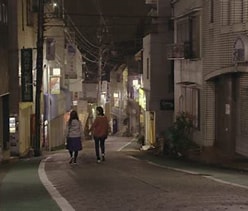
What is notable for present purposes is the extent to which this double lineage, this sense of a historical tradition born of necessity and a contemporary personal and cultural practice, is in evidence in Overnight Walk. It is a short film by a director unknown outside Japan but who has made several acclaimed shorts and seems set for bigger and better (certainly longer) things. The narrative concerns the action of the title as undertaken by two sisters. One, Sakura, is a struggling actress on the verge of accepting a small part in a film by a notable director. She is interested but agonizes over the need therein for a nude scene, about which she remains undecided, whilst her older sister, Yuriko, newly arrived in town and set to leave almost immediately, has some important news to impart, that she has recently got married. Together they decide (the decision being a significant aspect of the narrative) to walk through the night so they can catch up before Yuriko’s departure, and their journey through the city thereafter gives them time and space to catch up and mull over Sakura’s choice.
Stasis is a central to Overnight Walk as movement, both physical and otherwise, and indeed helps adumbrate walking as a thematic as well as a narrative referent. boyfriend, it is revealed, is out of work and has thus been all-but-house bound, a status that contrasts with Sakura’s professional and physical restlessness, her estrangement from the home. Given the unusual premise there is a fascinating variant here of the city symphony film. Where typical entries in this long-established mode (to which many established Japanese directors – from Ozu to Ichikawa Jun – have contributed) tend to celebrate the vibrancy and diversity of typically modern urban space and the peoples, practices and imperatives therein. Here empty streets, vacant spaces like a children’s playground and disposed denizens like a seemingly homeless man suggest a mirror image of such works. This after-hours city emptied of actions and inhabitants still causes consternation as the siblings struggle to find their way and become lost. The nocturnal streets become not only a stage for Sakura and Yuriko to play out the dramas of their lives. For the former, as an actress deliberating a nude scene, it is especially important as the conflict for her is about being seen, being exposed, and here she is both visible, in public, as well as concealed given the time of her journey, whilst for the latter a space away from the demands on her as a wife and member now of another family marks a welcome return to the familial bond of another time (exchanging families, as it were, is still common for women in Japan upon being wed). The after-hours city also figures as a physical manifestation of the siblings’ respective feelings. To this end they each have, if not secrets, then certainly thoughts, feelings, memories to bring to light, and the empty streets provide a spatial, topographical blank canvas upon which the sisters can write the stories of their lives and their relationship almost anew.
Several shots towards the end of the film, as sunrise breaks and the walk nears its destination and conclusion, show the city as it were coming to life. We see reflections in glass buildings, the first signs of people on the streets, and other such shots suggestive of a new day dawning. Is this a new start for the protagonist? Has she achieved some new perspective through her night out walking? The film suggests so, though it is a personal rather than a professional development. It was time away from time in a country where the official ordering of one’s temporal routines and attendant roles and responsibilities remains more pronounced here than in many others. It is time and space of specifically female discourse within a patriarchal culture with specific problems pertaining to men that needs must be resolved, and in this it is a significant film that deserves to be more widely seen than it has been, and, one fears, will be.
Dir. Isobe Teppei
Japanese Cinema Drama City Symphony